What Is a Verification Survey & Are They Useful?
Written by: P. Hooley | Published: 27th July 2026
In construction, accuracy matters from the very start.
A small difference in level, position, angle or alignment can have a big impact later in the project. It could cause clashes between trades, delays to the programme, expensive rework, or issues at handover.
That is where a verification survey can be extremely useful.
A verification survey provides an accurate, independent check of what has been built on site. It helps confirm whether the completed work matches the design information, agreed tolerances, drawings, models and client requirements.
Rather than relying on assumptions or visual checks, a verification survey gives project teams clear measured evidence. It shows what has actually been built and how that compares with what was intended.
For contractors, architects, engineers, project managers and asset owners, that information can support better decisions, reduce risk and provide greater confidence throughout the construction process.
In This Page
What Is a Verification Survey?
A verification survey is a measured survey used to check the true position, level, shape, alignment or condition of constructed works.
The survey data is captured on site and then compared against the design information. This may include construction drawings, setting out information, 3D models, BIM models, structural layouts, service routes or other project documents.
The purpose is simple. It helps answer the question 'Has the work been built correctly?'
Verification surveys can be used across many different parts of a construction project, including:
-
- Structural frames
- Walls and columns
- Floor slabs and soffits
- Steelwork
- Lift shafts
- Holding-down bolts
-
- Drainage routes
- Utilities
- Façades
- Service openings
- Fit-out elements
- As-built layouts
The survey does not replace the role of the design team, contractor or engineer. Instead, it provides accurate measured information so the relevant parties can review the findings and decide whether any action is needed.
In some cases, the survey may confirm that the work is within the required tolerance. In others, it may highlight areas that need further investigation, adjustment or remedial work.
How Does a Verification Survey Work?
The process usually starts with accurate site data capture.
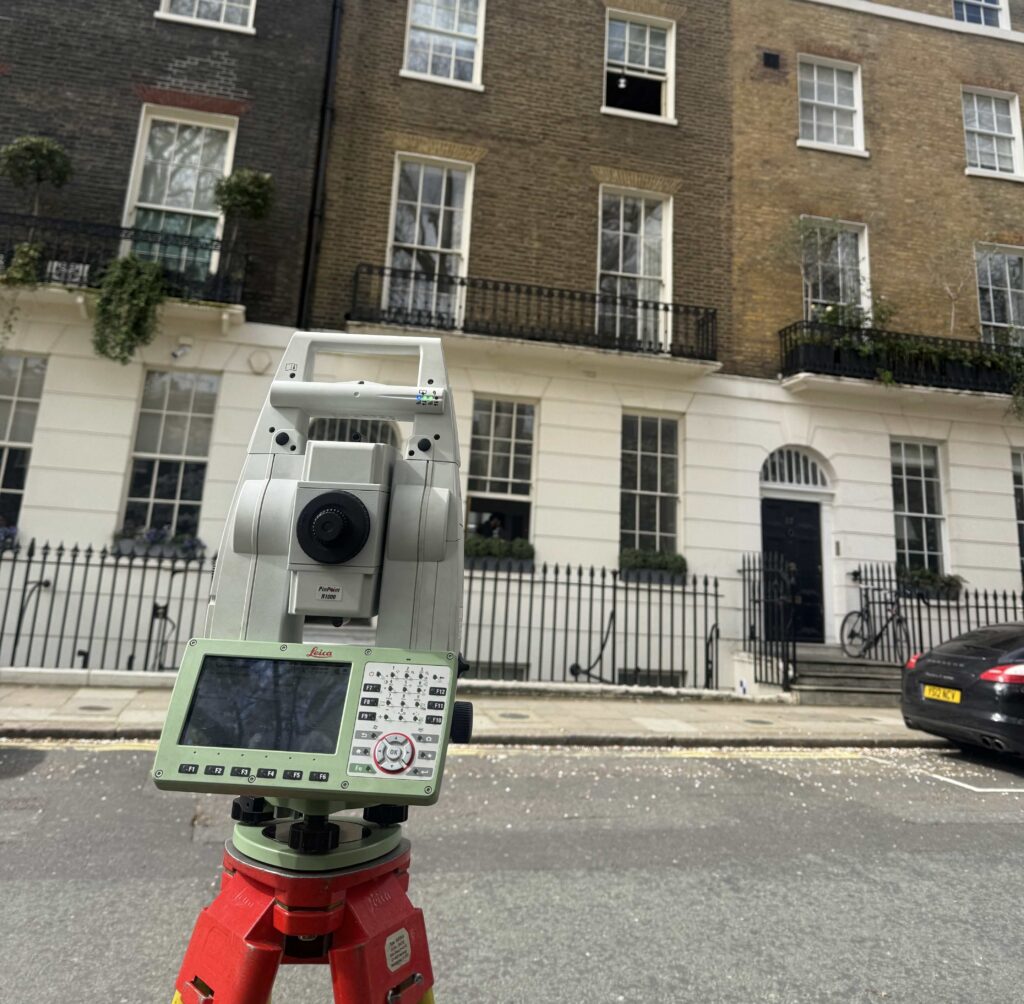
Depending on the project, this may involve equipment such as total stations, 3D laser scanners, GPS equipment or other specialist surveying tools. The method used will depend on what needs to be checked, the level of accuracy required and the environment being surveyed.
For example, a total station may be used to check precise points, levels and positions. A 3D laser scanner may be used to capture larger areas quickly and create a detailed point cloud of the site or structure.
Once the site data has been captured, it is processed into a usable format. This could include survey drawings, point cloud data, 3D models, tables, reports or visual outputs.
The measured information is then compared against the design information. This comparison can be presented in several ways, such as:
-
- Colour-coded deviation reports
- 2D drawings
- 3D views
- Point cloud overlays
- Marked-up plans
- Level comparison tables
- Written reports
- BIM model comparisons
The aim is to make the information easy to understand. A good verification survey should not just produce data. It should help the project team clearly see where the build matches the design and where it does not.
This is particularly useful when several teams are involved in a project. Clear measured outputs make it easier for everyone to understand the same information, discuss any issues and agree the next steps.
Why Are Verification Surveys Useful?
A verification survey can add value at many stages of a project. It is not just something to do at the end. In many cases, it is most useful when carried out during construction, before problems have the chance to affect the next stage of work.
1. They Help Reduce Costly Rework
Finding an issue early is almost always easier and cheaper than finding it later.
If a slab level, column position, bolt location or service route is wrong, it may not cause an immediate problem. However, once follow-on trades begin, that small issue can quickly become much more difficult to resolve.
A verification survey helps identify problems before they become embedded into the project. This can reduce the need for rework, avoid delays and help keep the programme moving.
For example, checking holding-down bolts before steelwork arrives on site can prevent installation issues. Checking slab levels before fit-out begins can help avoid problems with finishes, thresholds or service coordination.
The earlier the information is available, the more options the project team has.
2. They Improve Quality Control
Construction projects rely on accurate information.
A verification survey provides objective evidence that work has been completed in line with the design intent and required tolerances. It gives the team a reliable record of what has been built, rather than depending on rough measurements, photographs or visual inspections alone.
This can support internal quality assurance processes and provide confidence to clients, contractors and consultants.
It also creates a clear audit trail. If questions are raised later in the project, the team has measured data to refer back to.
3. They Support BIM and Digital Construction
As more projects use digital construction workflows, accurate as-built information has become increasingly important.
A verification survey can be used to compare real site conditions against BIM models, 3D models or digital design information. This helps keep project data aligned with what is actually happening on site.
Point clouds, model comparisons and deviation reports can all support better coordination between design and construction teams.
This is especially useful on complex projects where multiple trades, services and structural elements need to work together. By comparing the constructed work against the model, teams can identify differences early and make informed decisions based on accurate data.
4. They Give Confidence Before Handover
Before handover, clients and asset owners often need confidence that the finished work reflects the agreed design.
A verification survey can provide that reassurance. It can help confirm that key elements have been built correctly and that accurate as-built information is available for future use.
This information can support handover documentation, asset management, maintenance planning and future refurbishment work.
For building owners and facilities teams, having an accurate record of what has been built can be valuable long after the construction phase is complete.
5. They Help Manage Risk
Every construction project carries risk. Some risks relate to cost and programme. Others relate to compliance, coordination, safety, disputes or future maintenance.
A verification survey helps reduce uncertainty by providing clear, accurate information.
If there is a disagreement about whether something has been built correctly, measured survey data can support the conversation. If an issue needs to be investigated, the team has reliable information to work from.
It can also support valuations, compliance checks and project records, depending on the requirements of the job.
The main benefit is clarity. When decisions need to be made, the team is not relying on guesswork.
6. They Improve Communication Between Teams
Construction projects involve many different people, all working from different areas of expertise.
Designers, contractors, engineers, project managers, subcontractors and clients all need clear information to make good decisions.
A verification survey helps turn site conditions into something measurable and easy to understand. Visual outputs such as overlays, colour-coded reports and marked-up drawings can make complex issues much easier to explain.
This can reduce confusion, speed up discussions and help teams agree on practical next steps.
When Should a Verification Survey Be Carried Out?
Verification surveys are often most valuable when carried out at key stages of construction, rather than only at the end of a project.
For example, they can be used to check:
-
- Foundations before the next stage of works
- Holding-down bolts before steel installation
- Frame positions before cladding or internal works
- Slab levels before finishes are installed
-
- Service routes before ceilings or walls are closed up
- Drainage or utilities before backfilling
- Façade alignment before completion
- As-built conditions before handover
By checking these elements at the right time, project teams can reduce the risk of knock-on problems later in the programme.
On more complex projects, verification surveys may be carried out regularly as part of the quality assurance process. This gives the team a consistent flow of accurate information throughout the build.
They are also useful before handover, particularly where accurate as-built records are needed for client sign-off, compliance information, asset management or future maintenance.
What Should You Receive From a Verification Survey?
The exact deliverables will depend on the project, the scope of work and the type of information being checked.
However, a verification survey may include:
-
- 2D survey drawings
- Point cloud data
- 3D models
- BIM model comparisons
- Deviation reports
-
- Level reports
- Coordinate tables
- Marked-up plans
- Written findings
- Visual comparison outputs
The most important thing is that the output is clear and useful.
Before commissioning a verification survey, it is worth agreeing what needs to be checked, what tolerance is being used, what design information will be supplied and what format the results need to be delivered in.
A well-scoped survey will produce better information and make it easier for the project team to act on the findings.
Final Thoughts
A verification survey is much more than a box-ticking exercise.
It is a practical way to check that construction work has been delivered accurately and in line with the design. It gives project teams measured evidence, helps identify issues early and supports better decision making throughout the build.
By comparing what has been built against what was planned, a verification survey can reduce risk, improve communication, support quality control and provide greater confidence before handover.
For contractors, designers, clients and asset owners, it creates one of the most valuable things on any project: reliable information.
And when reliable information is available at the right time, projects are far easier to manage.
Stay updated with us:
How Can SolidPoint Help Your Project?
At SolidPoint, we are passionate about providing accurate and efficiently collected data for our clients and have worked on numerous projects across the UK. If you are looking to commission a survey in your next project, please don’t hesitate to Get in touch with a member of our friendly team to discuss your requirements and get a free quote.
Alternatively, you can call us on 01332 898350 or email us at projects@solidpoint.co.uk for more information on our services. We look forward to hearing from you!
Give us a call on
Request a Free Quote





Trusted Suppliers for: